
Get IT vs. Traditional MDM
Why terminology governance and human alignment matter just as much as master data governance.

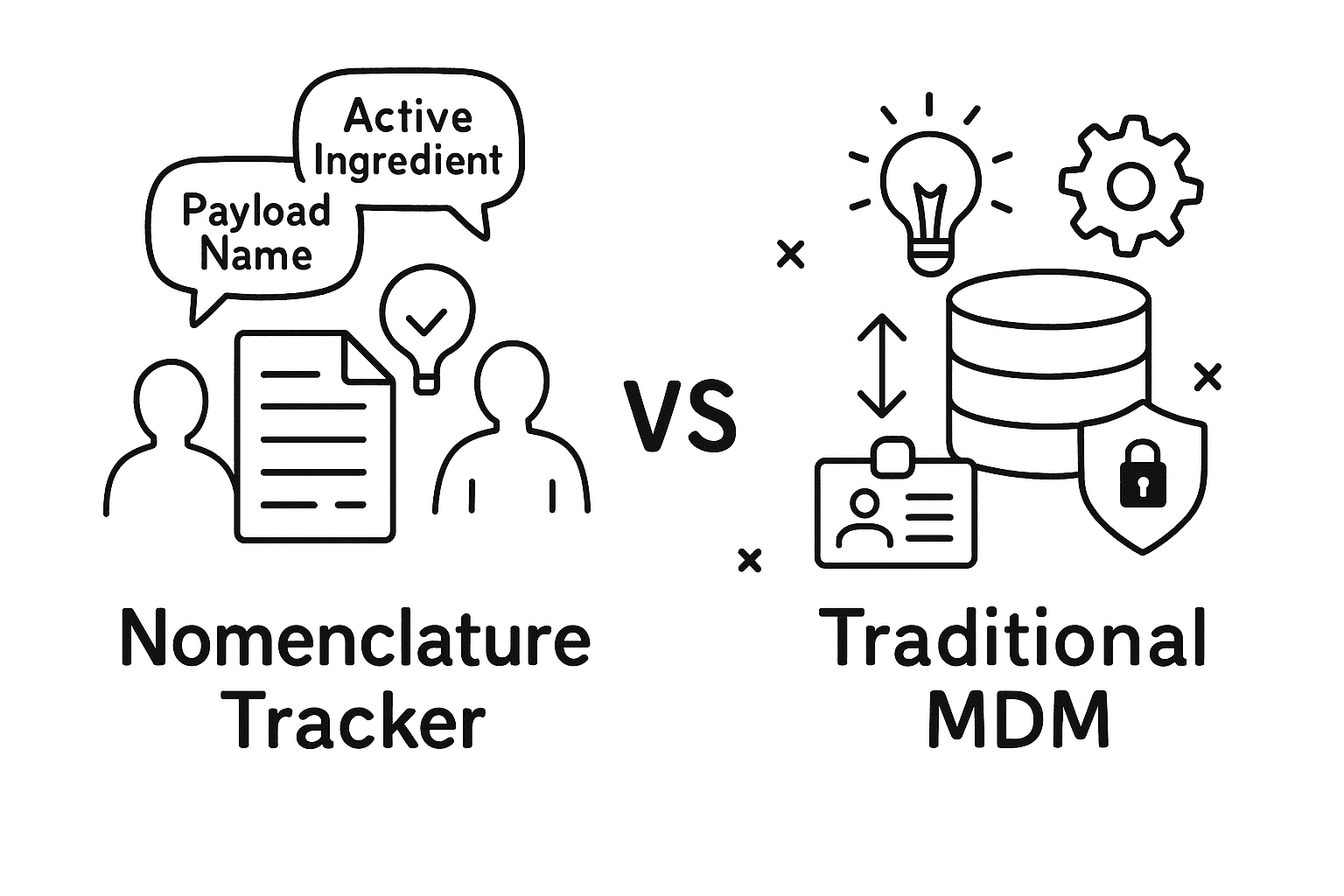
Get IT vs. Master Data Management (MDM)
Most teams hit the same wall on data consistency, and they assume the answer is “we just need MDM.”
That’s half true.
Traditional Master Data Management (MDM) tries to make your systems agree.
Get IT makes your people agree — and keeps them aligned as definitions evolve.
They solve related problems, but they’re not the same product class.
In practice, you usually need both.
Ready to standardize your organization's terminology?
Get IT helps teams create and maintain shared language, reinforce it with quizzes, and measure understanding across your organization.
Quick summary
- MDM: Creates and enforces a “golden record” for key business entities (Product, Material, Customer, Supplier, etc.). It focuses on systems, schemas, and data survivorship rules.
- Get IT: Creates and maintains shared language (what things are called, what they mean, and how they should be captured), and actively teaches that language back to humans and AI tools in the organization.
Think of it this way:
-
MDM answers:
“Is SKU-1234 the same thing as Product ABC in ERP vs. Product DEF in LIMS?”
-
Get IT answers:
"When we say 'active ingredient', are we talking about the compound base sequence, the formulated payload, or the registered trade name?"
“Does ‘lot’ mean batch, sub-batch, or fill/finish run in this group’s vocabulary?”
"When I write 'LabLIMS,' should I type 'LabLIMS', 'LAB LIMS', or 'Lab LIMS v8.7'? What's the canonical string we report in audits?"
Your auditors, regulators, operations teams, and downstream AI automations all care a lot about the second set.
The core problem Get IT solves
Most organizations don’t fail because they can’t technically match data. They fail because the inputs are inconsistent to begin with.
Examples you’ve probably seen:
- The same chemical is logged as
Compound_ABC123,ABC123,ABC-123 Compound, and "target active ingredient" depending on who typed it in. - A formulation team says “batch,” QC says “lot,” manufacturing says “production run,” and Finance thinks all three are the same thing.
- Trial labels, regulatory labels, internal labels, and marketing labels point at the same physical material but use different names.
MDM can reconcile those after the fact — sometimes — by mapping aliases to a canonical ID.
But MDM cannot stop humans (or vendors, or CROs, or robots, or a new hire at 2am) from inventing a brand new synonym and pushing it into the system tomorrow.
That's where Get IT lives.
We treat terminology like a living product:
- Capture it from uploaded documents (PDFs, Word docs, Excel files)
- Normalize it
- Version it
- Explain it in plain language
- Push it back to the teams that use it
- Measure who's aligned and who's not
Most companies discover they don't have a “data problem.”
They have a “no one agrees what we call things” problem.
Side-by-side comparison
| Capability | Traditional MDM | Get IT |
|---|---|---|
| Primary goal | Create and maintain a golden record (single source of truth) for master entities like Product, Customer, Supplier. | Create and maintain a shared language so humans, documents, automations, and AI all use the same terms the same way. |
| Owner | Data Governance / IT / Enterprise Architecture | Domain SMEs + Ops + Regulatory + Data/AI enablement |
| Where it enforces consistency | Databases, ERPs, CRMs, LIMS, PLM, Finance systems | Human-facing text fields, SOPs, forms, labels, tickets, emails, training decks, onboarding material, AI prompts |
| How it creates alignment | Matching rules, survivorship logic, deduplication, reference tables | Glossaries, approved terms, tags (synonyms), contextual definitions, version history, usage examples |
| Change management | Schema/version governance meetings; formal data stewardship review | ‘Term changed’ notifications, lightweight release notes, micro-quizzes to confirm teams actually adopt the change |
| Compliance / audit support | Can prove where a data value came from and which record 'won' in the golden record | Can prove that everyone is using controlled language consistently in documents, labels, COAs, submissions, and training |
| Time horizon | Stabilizes once core model is in place; updates mainly with new systems or M&A | Continuously evolves; reflects new science, new formulations, new regulatory language, rebrands, new SKUs, etc. |
| AI enablement | Feeds clean IDs and attributes into analytics/AI pipelines | Makes sure AI and RAG systems understand that 'base compound', 'active compound', and 'payload' are the same concept, and which version is authoritative right now |
| Human adoption loop | Rare. Usually training decks + SharePoint PDF nobody reads | Built-in just-in-time definitions, suggested terms, and short 10-20s check-ins (‘pop quiz’) to reinforce shared language across teams |
Why MDM alone doesn’t fix “terminology chaos”
Let’s walk a real pattern:
- Formulation Scientist logs material as
ABC-123 Compound payload (Field A). - QC labels it
ABC123 Active. - Manufacturing writes
Base 123. - Regulatory submission calls it
Compound_ABC123because that's what Legal approved last year.
An MDM platform can absolutely map all four of those to a single Product ID.
That helps downstream reporting.
But internally, you still have:
- Confusing labels on physical inventory
- Conflicting COAs
- Human conversations full of “wait, which one do you mean?”
- AI assistants that hallucinate because the synonym set is uncontrolled
That’s reputational and regulatory risk, not just data risk.
Get IT solves the upstream human problem: it standardizes what people are allowed to call things, and broadcasts that expectation everywhere they talk about those things.
Where Get IT sits in the stack
You don't "rip and replace" MDM for this. You layer Get IT alongside it.
1. Intake & discovery
We extract terms, acronyms, variant spellings, ingredient names, formulation codes, internal nicknames, etc. from:
- Uploaded documents (PDFs, Word docs, Excel files)
- SOPs and batch records
- Tech transfer docs
- Regulatory language
- PowerPoints and presentations
AI-powered extraction identifies technical terms automatically. You review and approve candidates before they become official glossary entries.
2. Canonicalization & context
For each concept, Get IT builds:
- Canonical term
- Tags (can function as synonyms)
- Human-readable definition (not legalese)
- Where it's used (Marketing? Sales? Manufacturing? QC? R&D? Regulatory?)
- Version history / when it changed
- Owner / steward
This becomes a living glossary for the organization.
3. Distribution & reinforcement
We don't just store terms. We push them back into the org:
- Micro-quizzes for onboarding or retraining ("Which of these terms is approved for COA labels?")
- Compliance tracking to verify team alignment
- Version history for audit trails
This is how you actually drive adoption, which traditional MDM never touches.
So is Get IT an MDM?
Short version: no.
More precisely: It’s complementary governance.
You can think of it like this layered model:
-
MDM / Product Master / Material Master / Customer Master
- “What’s the one true ID and record for this thing?”
-
Get IT
- "What are we officially calling this thing across science, operations, documents, submissions, and AI prompts — and are humans actually following that?"
Without #2, #1 has to constantly play cleanup.
Without #1, #2 doesn’t have a stable anchor to point at.
Good organizations run both. Weak organizations try to force one tool to do the job of both… and it never sticks.
Where Get IT drives the most value (fastest)
1. Regulated / audited environments
If wording drifts, you get findings.
We give you traceable “this is the approved term and why” plus evidence that teams were informed and trained.
2. R&D → Tech Transfer → Manufacturing handoff
The handoff usually breaks because terms mutate at every stage.
We act as a shared vocabulary layer across functions so people stop “translating” on the fly.
3. Onboarding / tribal knowledge
New hires ramp faster when they’re taught the actual words their team uses — not whatever was in last year’s slide deck.
4. AI copilots / “Ask the lab history” chatbots
LLMs need consistent language to retrieve the right context.
If five synonyms exist for the same active payload, retrieval quality tanks.
We compress synonyms into a controlled, versioned concept model the AI can understand immediately.
How to position this internally
When you pitch this to leadership, use this framing:
“We already pay for systems that try to merge data after it’s entered.
What we don’t have is a system that helps people (and AI) agree on what to call things before they enter it.”
or
"MDM makes our databases consistent.
Get IT makes our people consistent — and documents, and audits, and AI assistants."
Executives and QA leaders get that instantly.
TL;DR for procurement
- This is not a replacement for your current or planned MDM platform.
- This is the missing layer that:
- Captures and normalizes the vocabulary your teams actually use day to day,
- Publishes approved terminology back into the org,
- Verifies that people adopt it,
- Gives you proof of alignment for audits, tech transfer, AI governance, and training.
If MDM is "source of truth,"
Get IT is "source of meaning."
Teams that run both see smoother handoffs, fewer label fights, cleaner regulatory language, and way less ‘what do you mean by that?’ in meetings.
Bottom line
Traditional MDM protects the integrity of structured data.
Get IT protects the integrity of meaning.
If you care about auditability, onboarding, regulatory language, AI accuracy, and cross-team handoff — you need both.